Image

Night Stars – A Backwards Glance

Do you remember my post indicating a “Star was Born”?

I started working on this quilt as a free Block of the Month (BOM) offered by Craftsy.  I even chose to work from a kit, since Craftsy had a great deal on it.   After finishing the quilt (mostly to schedule), I decided to use it for longarm pattern layout “practice”.

The Night Stars quilt is a pattern by Kimberly Einmo.  The top is constructed with batiks from Anthology Fabric, and a black background with a mix of blues.  I liked the pattern as it gave me an opportunity to practice making a center medallion layout, which I had never tried before.  This is also the first quilt I have made with a black background and batting.

The quilting layout is custom, and used 4 different quilt pattern designers.
– Curls and Pearls (Found at Wasatch Quilting)
– Marilyns Lone Star set (Found at The Quilter’s Quilter
– Partial Pearl String (A carry over from a double wedding ring design)
– Enchanted Feathers – Susan Mallett (Found at Intelligent Quilting)

I used patterns from all four of these design sources to create the quilt fills. The layout of the quilting is my own. I never imagined what the result would be.  The top is colorful, and uniquely filled, but the result of the fills on the black batik back is stunning, and essentially made my quilt two-sided.  Friends have said it has both Indian, and Spanish tone.  I quilted it using my Handi-Quilter Avante machine, and Pro-Stitch.

I decided to follow what Kimberly Einmo suggested in her class regarding teal and yellow threads.  However, I chose a variagated thread for the star fills.  I am very glad that I did!

The back is my favorite part! What do you think?

EBrown_NightStarBack

As needed, I mirrored or rotated fills to give the patterns good flow.  It resulted in framing of the stars with flowers and feathers!  The center medallion,fill found at an Australian source: The Quilter’s Quilter, is my favorite part.

I decided to enter the quilt for consideration in two shows;

  • Home Machine Quilting & Sewing Show – Salt Lake City, UT / May 5 – 7, 2016
  • Quilt Odyssey – Hershey, PA / July 21 – 24, 2016

This is my first try at entering a show, and have been waffling back and forth between feeling like my quilt is “good enough” to enter for consideration or not.   I’m sure I will get some good feedback if they accept it for the shows, and doubt I would ever have trouble finding a home for this dark beauty!


Image

Out like a Lamb?

Today I am sharing the second block I have made from the Farmgirl vintage series.

A Lamb.

I couldn’t resist this one for my March post.  They say that if March comes in like a lion, it goes out like a lamb.  I sure hope we are not going to experience the flip side of that coin!

It is March 6th, and I am sitting in my office at 7 PM with 66 degree weather.  We have had the windows open all day!

I pulled the grass and the body fabric from grandma’s stash, but couldn’t resist using some little scraps of a modern print in the sheep face and ears.   The pattern calls for the head to be one large rectangle.  My pieces were too small, so I put together a four patch, then trimmed it to the correct size.  This will be a great way to use some of my smaller scraps in the construction. 

The legs are hand embroidered using a backstitch, and the eyes are a cross-stitch, just like the chick was in February.

What will the Farmgirl do in April?   I have an idea of the farming I might do in April…   I can hardly wait to get my hands dirty!

What are your suggestions?  I would love to hear from you!

Also,  did I mention that my mom liked the looks of my new pattern so much, she couldn’t resist ordering it during our visit to Prairie Point Quilt Shop last weekend!  She will probably have this one finished before me!

Image

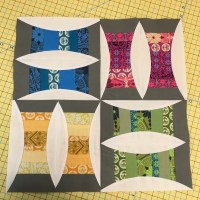
Curve it Up – Block 12 – Spinning Spools

My final block for the Curve it Up sampler quilt is completed.  I’m writing this from an altitude of over 14,000 feet after having about a day to recover from the pain…

image

I created this block using the suggested “scrappy” method where the middle of each spool is strip pieced from small scraps at least 5″ wide.   The result was that I misjudged the amount that a long pieced curve stretches while gingerly fed under the pressed foot.  I literally scrapped three spools before I settled on a method that let me trim them to the correct size.

This block requires that you trim to 4 1/2″ x 8 1/2″ by lining up the rectangle on points of both curves.   If your sides stretch, at least one of those points does not fit.

Tip1:   Starch everything.

The starch will help limit movement of the fabrics and seams cut on th bias.  I was not successful until I did this.

Tip 2:  Fewer seams = less chances for stretching as the seam bulk goes under the pressed foot.   ( I tried making the spool using a solid middle, and was successful the first time.)

In the future,  if I am in a scrappy spool mood, I have another idea.  I plan to stabilize the center of the spool using a very lightweight fusible stabilizer.   I think this would eliminate my issues with the bias and stretchy seams.

I’m really looking forward to piecing my borders and sashing next.  I hope your spinning spools go smoother than mine did.   Never give up, even if they make your head spin!   They do turn out pretty.


Image

Curve It Up – Block 11 – Temperance?

Who knew that some history of traditional quilt blocks could be found at the National Park Services website?  Check out this Quilt Discovery Booklet posted there.

The Drunkard’s Path from the Curve it Up pattern is the most traditional design in the book (my opinion).  “A Drunkards Path” consists of 16 blocks.

According to the Quilt Discovery Booklet, the Drunkard’s Path was popular during the temperance movement.  The Temperance Union colors were white for purity and blue for water, the “purist” beverage available.  I also made my block in Blue and White.  However, if you know the source and how water is processed in many municipalities, I would not call it pure…   If you live in the wrong place, you might even be drinking Lead.   Maybe we would all be safer drinking Gin and Tonic!

My favorite thing about this block is the fact that there are NO POINTS TO MATCH.   If you can match rows with nesting seams, then this block is for you.  It is a very forgiving curvy block. Temperance is not required.     Cheers!
If you are interested in the math of a drunkards path, read on. 


A traditional drunkards path uses a smaller radius of curvature, AND the center of the circle or arc is placed at the corner of the block.

The block created with the Quick Curve Ruler uses a flatter arc, or a larger radius of curvature and the radius is placed further away from the corner of the block.  You could create this same effect by creating your own template, but make sure that you have the arc hitting on equal sides of the square.

Here are some example diagrams.

Screen Shot 2016-01-27 at 8.45.59 PM.pngScreen Shot 2016-01-27 at 8.46.57 PM.png

When you cut traditional Drunkard’s Path blocks, the curve shown above is NOT your cutting line.  The reason for this is that it doesn’t account for your seam allowance.  Since you are stitching a concave piece to a convex piece, if you do not add additional seam allowance, your outside edges would not match.

The beauty of the Curve It Up pattern is that it suggests you start with a larger square than you need, stitch your curve, then trim the block to size. The method is used for all of the blocks in the pattern. I think this could be used for the traditional curved piecing as well, but you would need to increase your original squares of fabric to accommodate trimming to size and would have to be careful to keep curves centered.

If you are a math nerd…
I drew a curve using my Quick Curve Ruler and measured the length of a chord, and the height measured at the midpoint of the arc’s base.  Using those numbers I came up with a rough calculation of my Quick Curve Arc Radius.

Screen Shot 2016-01-27 at 9.00.10 PM.png

Quick Curve Ruler

Chord Length (W) = 6.5″
Height (H) = .75″

R = (.75/2) + (6.5*6.5)/(8*.75)
R = 7.416″

“To calculate the radius” above is from Math Open Reference Website:  http://www.mathopenref.com/arcradius.html


Image

A little sprinkle

There aren’t very many little girls in the family, so it is exciting for my aunt to have a granddaughter on the way.  This is my way to send good wishes for a healthy baby girl.

My mom wanted to give a quilt for the shower, so we got to work.  I found this fabric during a random stop to a local quilt shop, Harper’s Fabric and Quilt Co..  The backing came from a quilt shop near my mom, call Prairie Point Quilt & Fabric Shop.  It is from the Moda, Basic Grey fabric line, Mon Ami.  This is a little funny, since I found out that in french, “Ami” is the masculine version of friend!   Oh well.

I loved the grey raindrop fabric, and picked up a charm pack to create the tumblers in the center.  My mother and I pieced the top together using our own layout.  I like how the tumbler border gave the little quilt a feminine touch.

The quilting is a pattern called “Rain Drops” by Brandon Smythe of Intelligent Quilting.  I used blue variegated thread to give the pattern more depth.

It is a simple quilt, but I think will work well as “A Little Sprinkle” of good wishes for my cousin and his wife.

IMG_7907

Image

Curve It Up – Block 9 and 10

IMG_7895

Block 9, Dresden Plate, is the same as block 8, but assembled in a circle rather than fans.  (Fans are more forgiving.)
Marking and matching seams was the most important part of this block.  The seams are not pressed in opposite directions, so you WILL need to pin in order to match the seams perfectly.  I think I used better fabric values in this block and am happy with the outcome.

IMG_7899

Block 10 is the Piece Star Block.  I call it the “wish I squared my pieces up” block!   If I made this block again, I would be sure to square up my center diamond blocks.  I changed this design slightly by turning the corner background blocks into half square triangle blocks to introduce another color into the block.  I should have nudged my diagonal seam over by the width of my thread to make the blocks the perfect size for piecing.  All of these things would have made the block lie flatter when assembled. All of the seams create thick intersections, so I pressed most of the seam open to make them lie flatter.

Image

Lone Night Star – November

I am not sure where I have been for the last 2 months…
I have sewn, but not as much as usual. Since Thanksgiving we have visited family, celebrated a birthday, and generally enjoyed the season.  During a long weekend off from work, I have managed to reorganize my sewing room and finish the center of my Night Star quilt.  The center block, a Lone Star, is constructed using diamonds and triangles.  I like it.  The way the pattern uses all different colors and organizes them in color wheel order is very striking.

The important thing to remember during construction is to assemble the small triangles to the diamonds first, then add the larger triangles.  If you don’t do this, placement is much trickier.  I’m thankful that the Craftsy class mentioned this.

My end of year resolution is to assemble the quilt top.  Can I finish before he bell tolls?


Image

Night Stars – October – 54/40 or Fight

I finished the October blocks true to form… at the end of the month.   I think it is the cutting that always slows me down.

This month I broke down and bought the Tri-Rec tools to cut my fabric.  The last 54/40 or fight block I made was for a QOV and I wasn’t happy with the outcome.  I think I tend to shave material off of my thin plastic or paper templates.  Since these angles are a little fussy, I added to my ruler collection.

The great thing about the Tri-Rec tool is that you cut off a small ear on one corner of the triangle that is used to align it to the edge of another.  The piecing was very quick.

I find you can never have too many shoes or rulers! 🙂

I need to adjust my seam allowances still.  Every block turned out 1/8″ too small.  At this point it is better that I am consistent.  I will adjust on the next quilt, right?

I like the look of the 8 pointed stars better than the four point bursts.  What about you?

Image

The Home Stretch!

We are not huge sports or baseball fans, but I think that having the home team in the World Series makes the whole of Kansas City turn Blue!  The games have certainly been riveting.

Go Royals!  #Take The Crown

In the home team spirit, I finished two projects that I started this summer for my home.

One table runner is made from the Eleanor Burns, Quilt in a Day pattern, Autumn leaves.  This pattern called for the 4 1/2″ On Point Ruler, which is included with the pattern, and the 2″ x 4″ Mini Geese ruler, which was not…

IMG_7649

The other table runner and placemats were made, or inspired by the “Many Happy Returns” pattern by Patrick Lose.  I saw it in the July/August 2015 Fons & Porter’s Love of Quilting magazine and thought it would be perfect for my Blue Print Basics, Spring fat quarter bundle.  I didn’t use the pastels in this one.

IMG_7656

Image

Chains of Luck

Some projects have a way of blossoming. I started this quilt as a small scrappy lap quilt from some of my grandmothers stash. However, my dad visited while I was working on it and commented that it should be Queen size… Then he brought me a book of celtic knots for “inspiration” and made me a quilt ladder, complete with celtic knots and dragons for my birthday! SO, I made a queen size quilt, complete with quaternary knots, known for their luck! The quilt has double batting, cotton on the bottom, wool on top, to help the knots “pop”.
I’m such a lucky kid to have a great dad! Happy Birthday Dad!

IMG_7326